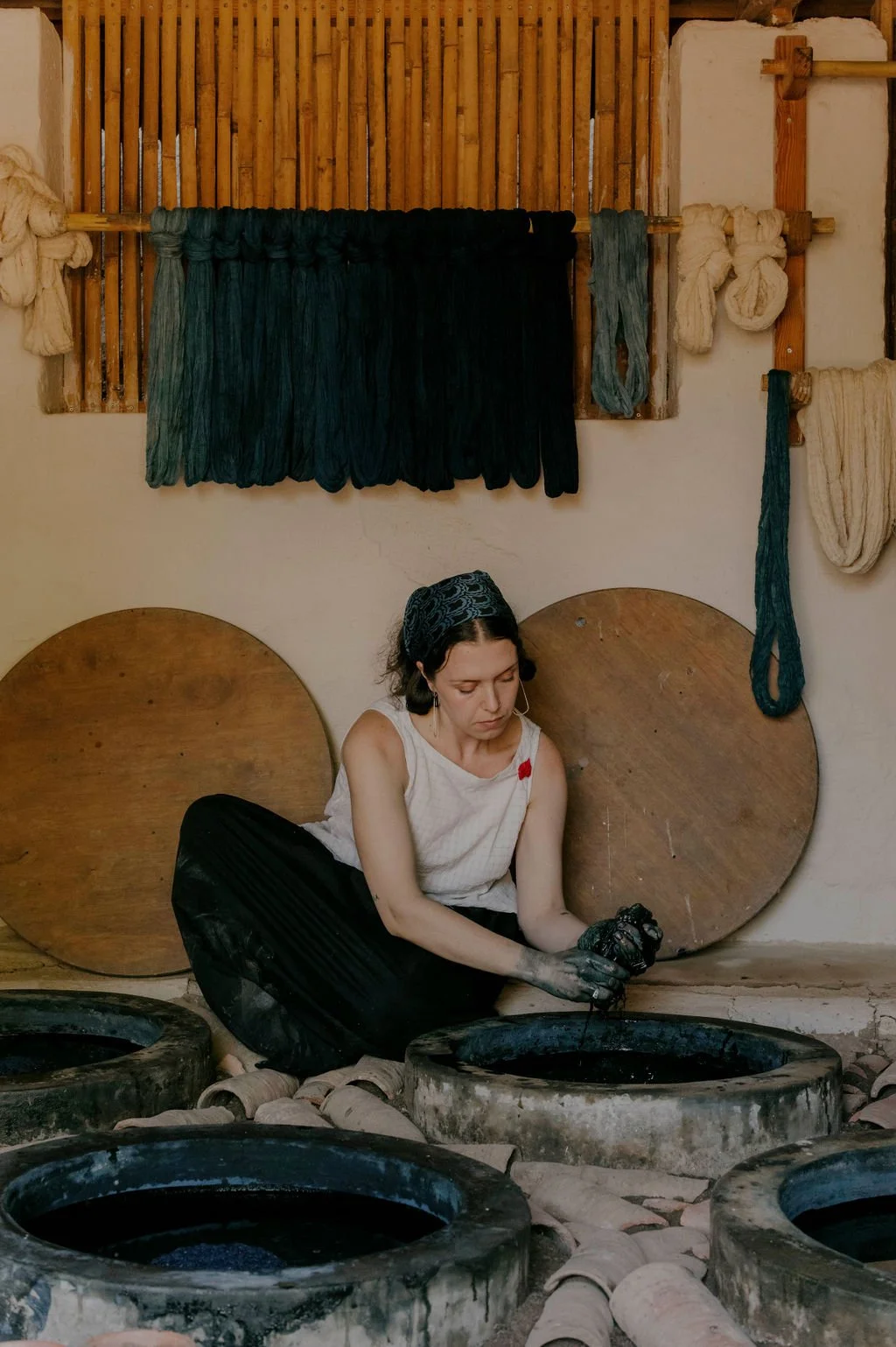
Artist Intro: Jessie Mordine Young
“I think what life is all about is having varied, dynamic, and expansive experiences. Travel only supports that”
–Jessie Mordine Young

Jessie with Thread Caravan founder Caitlin and travel companion companion Zak, walking the coast of Shetland.
For Brooklyn-based artist, educator, writer and curator Jessie Mordine Young, travel has always been more than a way of seeing the world; it is a way of truly understanding the world that we are rooted in. Her practice as a weaver has been greatly shaped through her experiences of travel - an evolving dialogue between place, materials, and people who uphold the legacy of traditional crafts. Jessie believes the life of a traveller holds a mirror to the life of a craftsman, both roles allowing you to develop a greater sense of empathy: “Craft is rooted in intention and care,” she says. “That's the same with travel. To be a good traveler, you have to be rooted in intention and care.”
Known for her small-scale tapestries, which she refers to as “woven drawings” or “thread sketches,” Jessie incorporates gathered materials from her travels, such as dried flowers, shells, beads, and stones, woven into natural fibre structures.
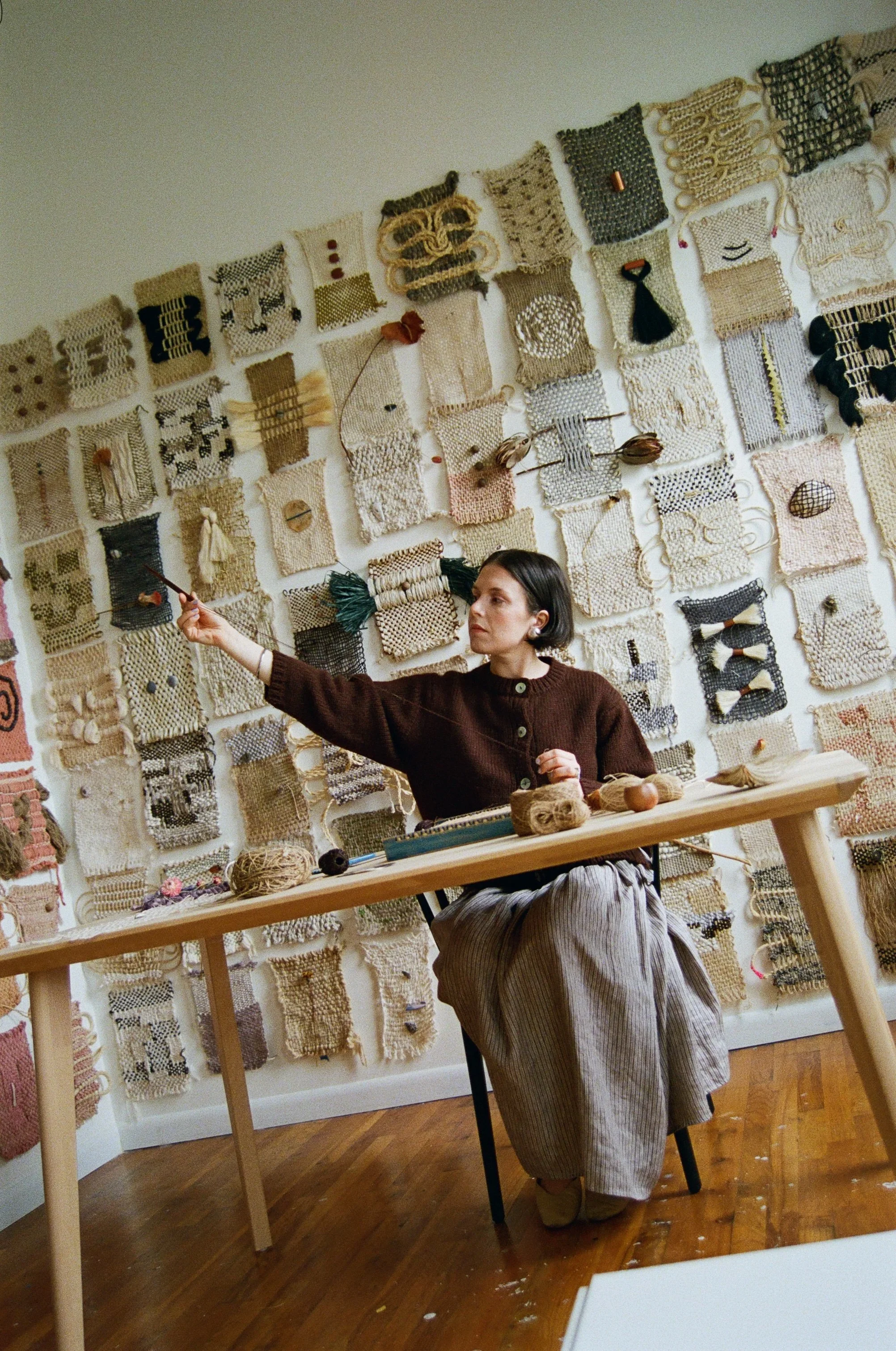
Jessie working in her Brooklyn studio, with her Woven Year series partially displayed behind her
For Jessie, this connection between craft and place began early in life. Born in England and raised in California's Bay Area, she spent significant periods between the US and India, following the separation of her parents, who each remarried partners of Indian origin. In India, Jessie predominantly resided in New Delhi, whilst traveling across many regions of the country – an enriching and vibrant experience during her most formative years. Moving between California and India gave her an early understanding of different cultural perspectives, ways of living, and the place that craft occupies in these contrasting heritages. She credits her upbringing and education in the Bay Area with giving her the freedom to experiment creatively, but it was in India that she was particularly introduced to the world of textiles. “Textiles are inherently a part of the social fabric of India,” she says. In India, families are bestowed as stewards of craft traditions; preserving them yet also finding ways to showcase their relevance in contemporary life.
Craft is not simply an object or a profession; it can be a way of life, rooted in intention and care, as she advocates. Jessie’s own art is a reflection of this philosophy. Through a daily weaving practice that became the foundation of her collection and first solo exhibition, A Woven Year, there is an intimacy and portability in the work. Her frame loom sits comfortably on her lap, allowing her to continue making while moving from place to place. Historically, she points out, many societies were nomadic and carried their crafts with them. “A portable practice can provide consistency,” she says, while removing the boundary of having to work in one particular studio or location. Making whilst moving allows Jessie’s work to emerge directly from experience and environment. “To be able to make as you travel supports a more honest and authentic practice,” she adds.
That approach was particularly evident during her recent Thread Caravan trip to Scotland. With her loom packed safely alongside her, Jessie spent mornings taking part in basketry workshops and afternoons walking through hills and pastures. As she travelled through the landscape, she collected stones, discarded rope and fishing line, seaweed, dried plants, sheep's wool, and other debris she encountered along the way.
The landscape itself became part of the experience. On this Scottish island, Jessie was struck by the concept of the Right to Roam, which allows people to cross private land and move through the countryside in this nation freely. Compared with the United States, where boundaries and private property can feel much more defined, the idea of moving freely, along with the vast landscape Shetland offers, provided a physical and mental spaciousness for Jessie, opening her mind for new ideas to unfold - bringing new ideas for a more sculptural direction to develop in her future work, inspired by the basketry techniques she was being introduced to.


Accustomed to the busy streets of New York City, Jessie describes Shetland as a place where she could experience a rare sense of solitude. Walking along the cliffs without seeing anyone, she felt as though she was on “the edge of the world.”
The harsh weather conditions of this environment, she says, revealed a sense of resilience – not only in the natural world, but in the communities that live within it. She found herself drawn to the ability of plants to survive in exposed environments and to the strength required to live in such conditions.
That resilience has an obvious connection to weaving. Both demand patience and sustained attention. The repetitive process of making creates a different rhythm from the pace of everyday life, just as remote landscapes can interrupt the routines of a city.
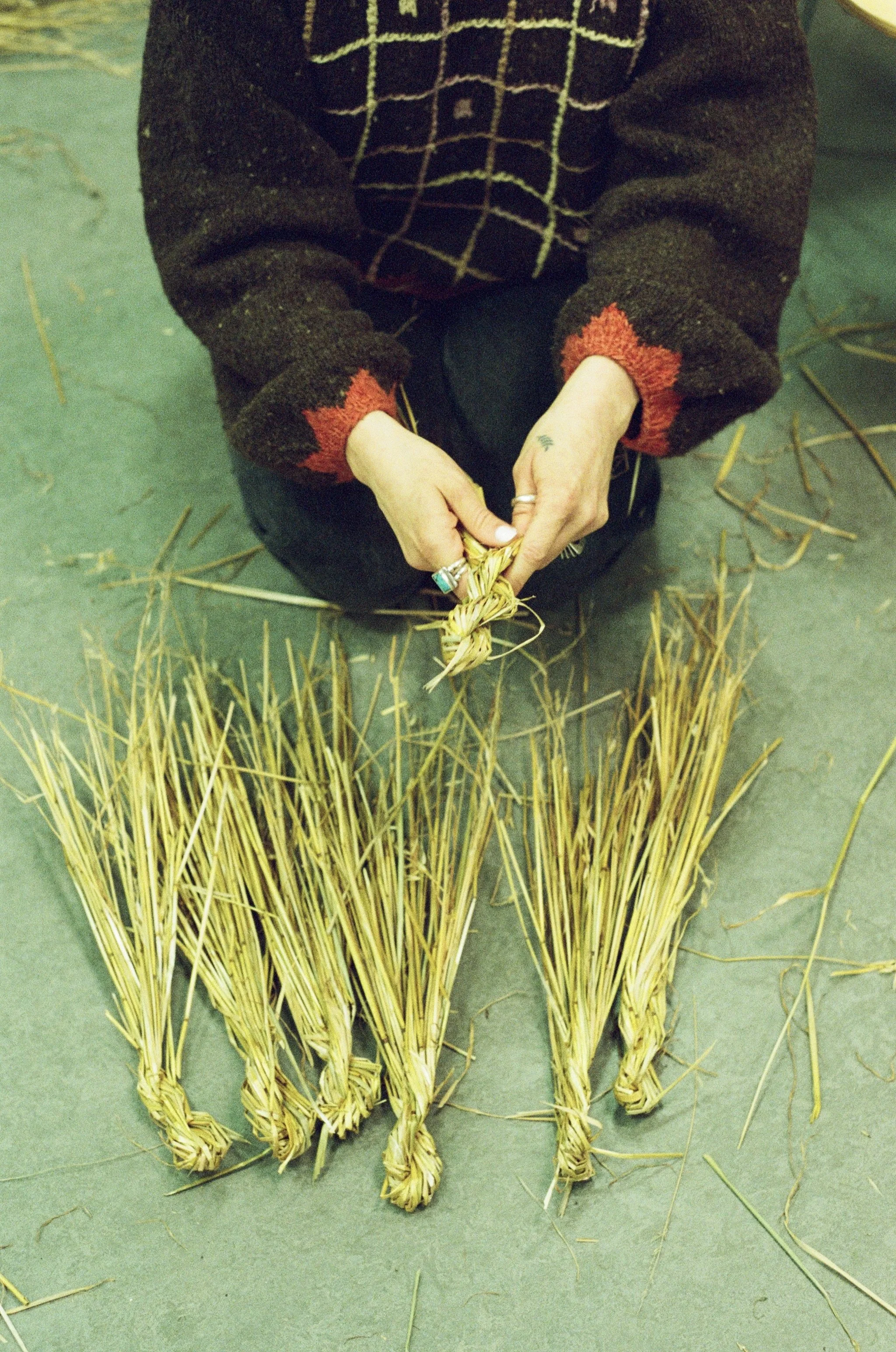
Jessie twisting Shetland oat straw in preparation to weave a kishie with guidance from local basket weavers and teachers Eve and Catherine.
“With weaving, time is slower. It feels like it almost stops,” says Jessie. She found a similar sensation in Shetland, where weather and the natural world influence everyday life. When the sea is rough, for example, boats may not run. Seasonal changes and the extraordinary summer light can make the usual markers of time feel less distinct.

Taking a cold dip in the North Sea
Jessie has embarked on a number of the Thread Caravan trips. Some of her warmest memories come from the artisans she meets who dedicate their lives to their craft. Recalling a trip to Morocco, she describes being deeply inspired by Mama Aicha, an artisan whose life revolved around a commitment to clay. That kind of sustained creative practice is something Young hopes to cultivate throughout her own life.
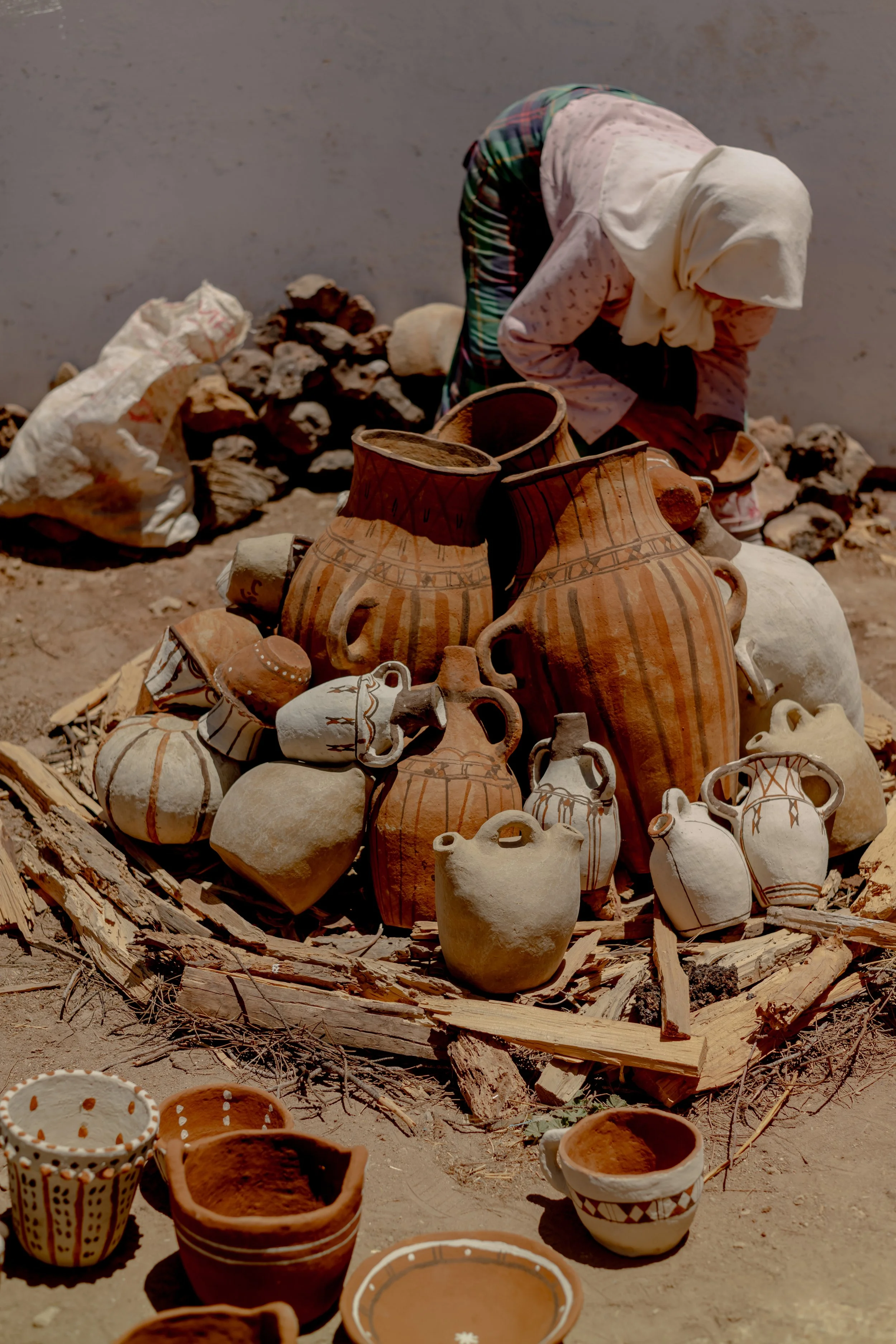
Mama Aicha preparing ceramic pieces for a firing
Jessie’s studies began at the School of the Art Institute of Chicago, with a dual degree in Art History and Studio Art in Fiber and Material Studies, and later a Masters Program in the History of Decorative Arts, Design History, and Material Culture at the Bard Graduate Center in New York City in 2021.
After a stint in art curation, Jessie found herself wanting to be rooted within a practice of making, specifically weaving. But spending around a decade working in the museum world was integral.
“Through curatorial and collection work I was introduced to the context surrounding objects and the meanings they carry,” she says. A narrative that is shared on each Thread Caravan trip. “When we're making these objects, we're not just making something to use, we're really making in order to understand. And not only understand the object itself, but the people who make them.” Jessie is now developing a series of around 20 to 30 pieces inspired by her trip to Scotland, incorporating her foraged materials.
Alongside her weaving practice, Jessie has been working on a book focused on how-to techniques and an introduction to frame-loom weaving, due to be published in 2027.
Teaching and sharing knowledge is at the core of her work. Jessie is a lecturer at Parsons School of Design in New York, and has a thriving workshop program facilitated from her studio and online each month. Looking ahead, Jessie is hoping to move towards teaching more in a retreat format – an approach that reflects the immersive experiences she has valued on her own travels.
These immersive, slower experiences are ones that foster community, which is fundamental to craft.
People historically gathered together to make, share knowledge and sustain one another. In that sense, craft can be understood as a form of resilience. Resilience, in turn, depends on a strong core community.
For Jessie, with travel, weaving, and learning all flowing hand in hand, she has fostered her most authentic practice. These elements all bring a call to paying attention through her daily life, whether she is walking across a remote Scottish landscape, learning from an artisan in another country or sitting with a frame loom on her lap in her studio in Brooklyn.
Jessie will be co-leading the Thread Caravan Crafts of Kutch tour from 14-21 January 2027, where travelers will explore spinning, weaving, copper bell forging, and embroidery, with artisans Shamji Vankar Vishram Valji, Abdullla Kharti, and Janmamad Salemamad Luhar amidst the expansive Rann salt marsh in Kutch, Gujarat, India.